as requested,here are the topics for mock examination.
POA
1.correction of error.
2.partnership.
3.amalgamation.
4.bad/doubtful debts.
5.depreciation.
6.tpi + b/s + bal day adj.
MATHS
1.matrices.
2.coordinate geometry.
3.quadratic equation & algebra.
4.inequalities.
5.indices & standard form.
SOCIAL STUDIES
choose one.
1.bonding singapore.
2.governance.
3.healthcare.
CHEMISTRY
1.particulate of matter(acids,bases and salts)
-describe the solid,liquid and gaseous states of matter and explain their interconversion in terms of the kinetic particle theory and of the energy changes involved.
-classify oxides as acidic,basic,amphoteric or neutral based on metallic/non-metallic character.
-describe the techniques used in the preparation of salts(precipitation).
2.purification.
-separations and purification using paper chromatography.
3.atomic structure.
-define the term isotopes.
-deduce the numbers of protons,neutrons and electrons in atoms and ions given proton and nucleon numbers.
4.atomic structure(chemical bonding).
-define proton number(atomic number) and nucleon number(mass number)
-write electronic structures of atoms and ions.
-describe the formation of ions by electron loss/gain in order to obtain the electronic configuration of a noble gas.
-deduce the formulae of ionic compounds from the charges on the ions present and vice cersa.
5.air pollution(mole concept).
-state the sources of SO2 as sulfur dioxide from volcanoes and combustion of fossil fuels.
-calculate stoichiometric reacting masses and volumes of gases(one mole of gas occupies 24dm3 at room temperatire and pressure).
6.energy changes(periodic table).
-describe the term exothermic as a process or chemical reaction which transfers energy,often in the form of heat,to the surroundings and may be detected by and increase in temperature.
-describe lithium,sodium and potassium in Group 1(the alkali metals) as a collection of relatively soft,low density metals showing a trend in melting point and in their reaction with water.
7.organic chemistry.
-describe the properties of alkenes(exemplified by ethene) in terms of combustion and the addition reactions with bromine and hydrogen.
-describe the properties of alcohols in terms of combusion and oxidation to carboxylic acids.
8.organic chemistry.
-describe the formation of ethanol by fermentation of glucose.
-describe the manufacture of alkenes and hydrogen by cracking hydrocarbons and regconise that cracking is essential to match the demand for fractions containing smaller molecules from the refinery process.
9.air pollution.
-describe use of catalytic converters to control level of pollution.
10.qualitive analysis(acids,bases and salts).
-identification of ions and gases.
-describe use of indicators to determine pH of solutions.
11.rates of reactions(mole concept).
-describe the effect of concentration,pressure,particle size and temperature on the speeds of reactions and explain these effects in terms of collisions between reacting particles.
-interpret data obtained from experiments concerned with speed of reaction.
-draw experimental set up.
-apply the concept of solution concentration(in mol/dm3 or g/dm3) to process the results of volumetric experiments and to solve simple problems.
five-cee-two.bs.com ; Y

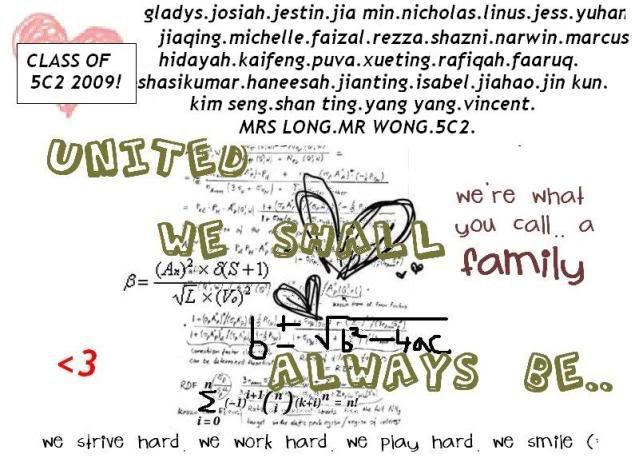
THE 5C2-ERS.

We're a FAMILY!
We're BRILLIANT!
We're FRIENDLY!
We're ROWDY!
We're CRAZY!
We're NOISY!
We're WILD!
We're COOL!
We're FUN!
We're Anything SWEET&NICE!

CBOX
GLADYS LIM KE YUN(treasurer).
JOSIAH GOW RONG EN(management head).
JESTIN GOH.
KWEK JIA MIN(chairperson).
LAI ZHENG LIANG NICHOLAS.
LEE KIA MIN LINUS(welfare head).
LEE YUXIAN JESS.
LIAN YUHAN.
LIM JIA QING.
MICHELLE TEO WEI SEN(assistant welfare).
MUHAMMAD FAIZAL B JURIMI.
MUHAMMAD REZZA ADAM B MOHD Z.
MUHAMMAD SHAZNI BIN KAMARUDIN.
NARWIN SINGH MANN(discipline head).
NEO JUNN HAO MARCUS.
NUR HIDAYAH BTE ZAINAL(english rep).
PHNG KAI FENG.
PUVANESWARRI D/O SWAMINATHAN.
QIAN XUETING.
RAFIQAH BTE MD RASID
SHAIK FAARUQ S/O SHAIK MOHAMED.
SHASIKUAMR S/O PERIASAMY(poa rep).
SITI HANEESAH BTE ZULKIFLI.
TAN JIAN TING.
TAN MAY EN ISABEL.
TEO JIA HAO.
TEO JIN KUN.
TEO KIM SENG(chinese rep & assistant management).
TOH SHAN TING(vice-chairperson).
TOH YANG YANG(assistant treasurer).
VINCENT LAI YOONG KANG(it rep).
CLASSPARENT-mrs irving long.
CO-CLASSPARENT-mr wong soon yeow.
GODMA-miss ng hian koon.
ENGLISH-mrs teresa chua.
MATHS-mrs irving long&mdm ho.
POA-miss choo beng hoon.
GEOGRAPHY-miss ng hian koon.
SOCIAL STUDIES-miss ng hian koon.
CE-mrs irving long.
PE-mrs jessie sam.
CHEMISTRY-miss tan wen yi.
BIOLOGY-miss charlene seah.
PHYSICS-mr kamal
CHINESE-mr wong soon yeow
ART-mdm maimona
FNN-mdm ang
DNT-miss iris ng

kwekJIAMIN
JESSlee
lianYUHAN
MICHELLEteo
HIDAYAHzainal
qianXUETING
RAFIQAH
HANEESAH
tanJIANTING
ISABELtan
tohYANGYANG
5C2 is LOVED.(:

|March 2009|
|April 2009|
|May 2009|
|June 2009|
|July 2009|

5C2. :D
We're BRILLIANT!
We're FRIENDLY!
We're ROWDY!
We're CRAZY!
We're NOISY!
We're WILD!
We're COOL!
We're FUN!
We're Anything SWEET&NICE!
PEOPLE OF 5C2.
TEACHERS. (:
CO-CLASSPARENT-mr wong soon yeow.
GODMA-miss ng hian koon.
ENGLISH-mrs teresa chua.
MATHS-mrs irving long&mdm ho.
POA-miss choo beng hoon.
GEOGRAPHY-miss ng hian koon.
SOCIAL STUDIES-miss ng hian koon.
CE-mrs irving long.
PE-mrs jessie sam.
CHEMISTRY-miss tan wen yi.
BIOLOGY-miss charlene seah.
PHYSICS-mr kamal
CHINESE-mr wong soon yeow
ART-mdm maimona
FNN-mdm ang
DNT-miss iris ng
JESSlee
lianYUHAN
MICHELLEteo
HIDAYAHzainal
qianXUETING
RAFIQAH
HANEESAH
tanJIANTING
ISABELtan
tohYANGYANG
|March 2009|
|April 2009|
|May 2009|
|June 2009|
|July 2009|